Title here
Summary here
Launchers
In many games, the primary method of scoring involves launching a game object (such as a ball, disc, ring, beanball, or triball) into a high or distant target. To achieve this, robots utilize a Launcher mechanism.
Most generally, a launcher is any mechanical system designed to store potential energy and convert it into a lot of kinetic energy to propel an object through the air. Rather than relying on simple, low-velocity pushes, a launcher allows a robot to score points dynamically from completely across the playing field.
Classification of Launchers
Kinetic launchers rely on rotational inertia. They use high-speed motors to spin a massive wheel or set of wheels continuously. When a game piece is fed into the active wheel, the wheel transfers its stored kinetic energy to the object, launching it forward via friction and compression.
Elastic launchers rely on deformation. They use rubber bands, latex tubing, or metal springs to store potential energy over time. A motor gradually pulls a launching arm or linear piston backward against the resistance of the elastics until it passes a mechanical “drop-off” point, instantly releasing all stored tension in a singular, violent burst.
The Math
The main math behind any launcher is the physics of projectile motion. The instant an object leaves your launcher’s barrel, its flight path is a parabola governed by its Initial Velocity (v0) and its Launch Angle.
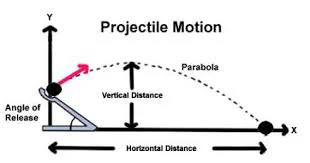
The initial velocity can be broken down into horizontal (vx) and vertical (vy) components.
$$ v_x = v_0 \cos{\theta} $$$$ v_y = v_0 \sin{\theta} $$Using these vectors, the theoretical horizontal distance or Range ($R$) of a projectile launched from ground level over a flat field is calculated using the range equation:
$$ R = \frac{v_0^2 \sin(2\theta)}{g} $$Where:
Because velocity (v0) is squared in the equation, a tiny increase in your flywheel’s RPM or your catapult’s elastic tension will result in a massive increase in firing distance.
The 45 degree Rule: Mathematically, a launch angle of exactly 45 degrees maximizes horizontal range sin(2 * 45) = sin(90) = 1. If your target is exceptionally high or low, you must adjust this angle structurally to balance flight time against horizontal distance.
When designing a launcher, you might face a balancing act between Cycle Time (how fast you can shoot) and Structural Power (how far you can shoot).